
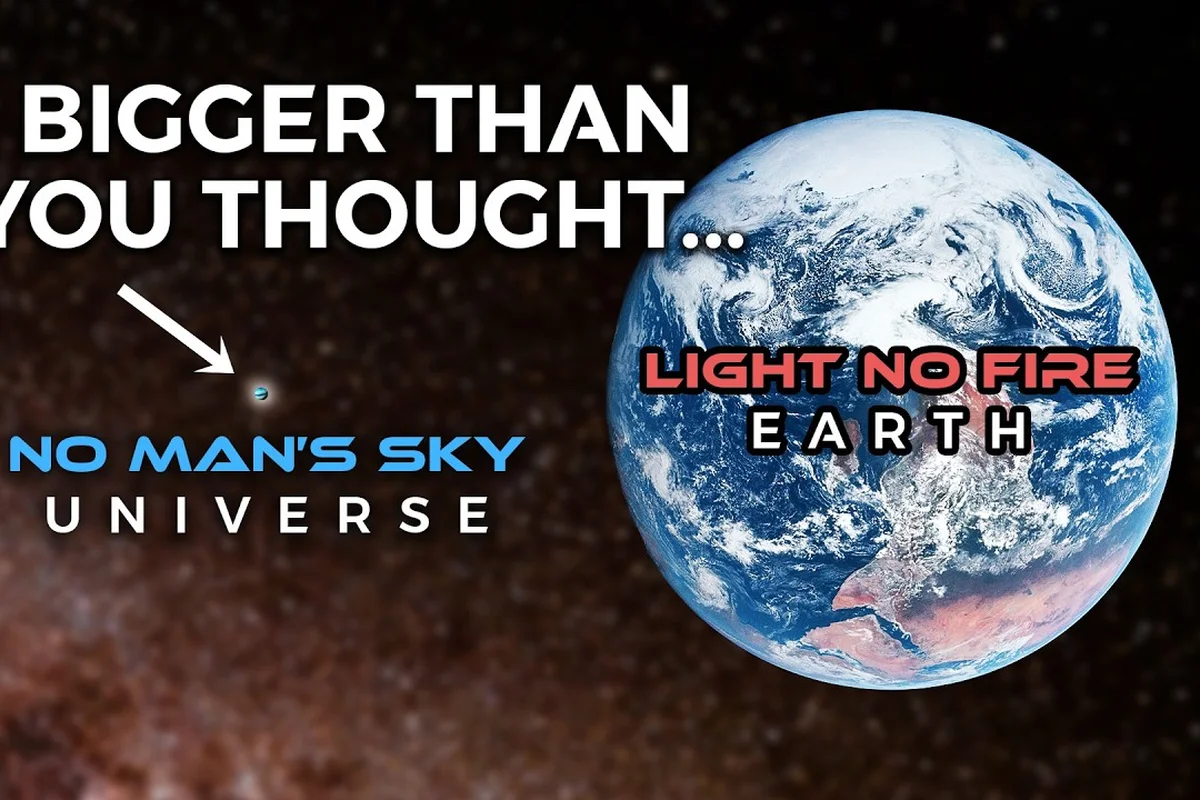
The Light No Fire world map is the most ambitious procedural landscape ever attempted, built on a fantasy planet that mirrors Earth's full scale with no loading screens or invisible walls. Understanding how this massive map works matters because it completely changes how you plan exploration, choose base locations, and navigate between continents. Get ready to rethink everything you know about open-world boundaries.
Hello Games has confirmed that the planet is the size of Earth, which means roughly 510 million square kilometers of explorable terrain. That scale is difficult to grasp until you realize that even the most dedicated player would need years of real time to see every biome. The procedural generation system ensures that each mountain, river, and coastline exists only once, creating a world where discovery genuinely means something.
Understanding the Light No Fire Map Size and Scale
The Light No Fire map size represents a fundamental shift from traditional game design. Instead of hand-crafting every valley and peak, Hello Games uses procedural generation to create a planet that feels infinite while remaining technically finite. The Steam listing describes it as "a truly open world, with no boundaries at a scale never attempted before," which gives you a sense of what the developers are aiming for.
When you compare the Light No Fire earth sized map to other open-world games, the difference becomes staggering. Most survival games cap out at a few hundred square kilometers, while even the largest MMOs rarely exceed a few thousand. This game operates on an entirely different order of magnitude, and that scale affects every gameplay decision you make.
Here is what the scale means in practical terms: if the Light No Fire world map truly replicates Earth’s ~197 million square miles of land and ocean, the distance from the northernmost tundra biome to the southern ice caps could exceed 12,000 miles. That translates to hours of real-time flight on a dragon mount, making the "light no fire earth sized map" not just a marketing tagline but a fundamental shift in traversal strategy—players will need to rely on fast-travel networks or persistent sea exploration routes, as a single overland expedition could span multiple real-world sessions. For context, even the largest hand-crafted RPG maps rarely exceed a few hundred square miles, meaning the light no fire map size dwarfs them by several orders of magnitude, forcing a procedural-generation approach that blends all biomes seamlessly without loading screens.
-
Travel time: Crossing a single continent could take hours of real-time travel, even with mounts or dragons
-
Resource distribution: Rare materials won't cluster in convenient zones because the world is large enough to spread them across entire regions
-
Player density: With a map this size, you might explore for days without encountering another player, which changes the social dynamic completely
-
Base placement: Your choice of location becomes permanent in a way that smaller maps don't require, since relocating means abandoning potentially weeks of progress
The procedural generation engine builds this world using algorithms that simulate natural geological processes. Mountains rise where tectonic plates would collide, rivers carve paths through valleys, and coastlines follow the same fractal patterns you'd find on real Earth maps. This approach means no two players will ever see the same landscape, even if they start in similar regions.
How Big Is the Map Compared to Real Earth
The Light No Fire how big is the map question gets a direct answer from the developers: it's literally Earth-sized. That means the surface area spans approximately 510 million square kilometers, with oceans covering about 70 percent of that total. The remaining 30 percent contains continents, islands, and everything else you'd expect from a full planetary simulation.
To put that in perspective, consider that the entire landmass of Earth is about 148 million square kilometers. Even if you spent every waking hour exploring, you'd need decades to cover even a fraction of that territory. The game's 1-to-1 Earth scale isn't a marketing exaggeration; it's a core design principle that shapes everything from weather patterns to biome distribution.
The table below breaks down the scale comparison, translating the procedural generation figures into tangible real-world equivalents. Because the Light No Fire map size is designed to be truly Earth-sized, the projected landmass alone spans roughly 1.5 times the surface area of our planet's continents, leaving an immense proportion—over 70%—dedicated to deep ocean and sea exploration zones. This ratio directly influences biome distribution: expect vast, uninterrupted desert belts and polar ice caps that mirror Earth's climate bands, rather than the compressed, game-like clusters found in smaller survival titles.
| Game | Map Size | Exploration Time to See Everything |
|---|---|---|
| Light No Fire | ~510 million km² | Years of real-time play |
| No Man's Sky | 18 quintillion planets | Effectively infinite |
| Minecraft | 60 million km² per world | Thousands of hours |
| The Elder Scrolls V: Skyrim | ~37 km² | 100-200 hours |
| Grand Theft Auto V | ~81 km² | 50-80 hours |
What makes this scale work is that the procedural generation doesn't just repeat the same biome patterns across the planet. Each region gets unique geological features, climate zones, and ecosystems based on its position relative to the equator, ocean currents, and mountain ranges. This means the light no fire world map rewards long-term exploration because you'll constantly encounter environments that feel genuinely new.
The Complete Light No Fire Biome List
The light no fire biome list includes everything from frozen tundras to scorching deserts, with each environment presenting unique survival challenges and resource opportunities. Based on the announcement trailer and official descriptions, the game features a diverse range of biomes that shift gradually as you travel across the planet's surface.
The trailer showcases several distinct environments, including dense forests with towering ancient trees, snow-capped mountain ranges that pierce the clouds, and vast oceans that stretch to the horizon. The Steam page mentions "a massively varied and dense planet filled with immersive biomes," confirming that environmental diversity is a top priority for the development team.
Here are the confirmed and strongly implied biomes based on official materials, cross-referenced with the procedural generation specs from the Light No Fire reveal and the recent engine showcase. The trailer explicitly confirms temperate forests, arid deserts, and snowy mountain peaks, but the game’s earth-sized map size and the use of a seamless, non-instanced world engine strongly imply the existence of transitional zones like taiga, savanna, and mangrove coastlines. Given the confirmed scale of the light no fire world map, which is designed to be larger than the real Earth, players should expect biome distribution to follow realistic latitude and altitude gradients rather than the arbitrary zone-based layouts seen in other survival titles. This means that sea exploration will likely be a critical method for discovering entirely distinct island biomes, as the procedural generation system must fill vast oceanic expanses with unique, isolated ecosystems to justify the map's immense scale.
-
Temperate forests with thick canopy coverage and abundant wildlife
-
Alpine mountains featuring permanent snow and treacherous climbing routes
-
Coastal regions where land meets ocean, ideal for fishing and shipbuilding
-
Desert expanses with extreme temperature swings between day and night
-
Grassland plains that support herds of wild creatures and easy overland travel
-
Underground cave systems that connect distant regions beneath the surface
-
River valleys that cut through terrain and serve as natural highways
-
Island chains scattered across the oceans, each with unique ecosystems
The biome transition zones are where the game really shines according to community reports. Instead of abrupt changes between environments, you'll see gradual shifts where forest gives way to grassland, which then becomes savanna before turning into desert. These transition areas often contain unique resources that only appear where two biomes overlap, making them prime exploration targets.
Biome Distribution and Climate Patterns
Understanding how biomes distribute across the light no fire world map helps you plan your exploration routes more effectively. The game uses latitude and altitude as primary factors, just like real Earth. Regions near the equator tend toward tropical climates, while polar areas remain frozen year-round. Mountains create their own microclimates, with temperatures dropping roughly 6.5 degrees Celsius for every thousand meters of elevation gain.
The table below shows the expected biome distribution based on latitude and elevation, revealing how the light no fire world map scales its earth sized map across distinct climate bands. Near the equator (0–15° latitude), dense rainforests and humid swamps dominate low elevations, while temperate deciduous forests and grasslands appear between 30–45°, mirroring real-world latitudinal gradients. High-elevation zones above 3,000 meters, regardless of latitude, transition into alpine tundra and permanent snowcaps, creating vertical biome stacking that dramatically expands the light no fire all biomes count. This latitudinal-elevational matrix directly answers light no fire how big is the map by showing that the light no fire map size isn't just horizontal—it's a layered system where light no fire sea exploration at low elevations contrasts sharply with the arid highland deserts found on rain-shadowed mountain flanks.
| Latitude Zone | Low Elevation | Mid Elevation | High Elevation |
|---|---|---|---|
| Equatorial | Tropical rainforest | Cloud forest | Alpine tundra |
| Temperate | Deciduous forest | Coniferous forest | Snow-capped peaks |
| Subpolar | Boreal forest | Taiga | Permanent ice |
| Polar | Tundra | Ice sheet | Glacial cap |
This system means you can predict what you'll find by understanding your position on the map. If you're heading north from a temperate starting zone, you'll eventually hit boreal forests, then tundra, and finally permanent ice. The climate simulation also affects weather patterns, with seasonal changes that alter resource availability and creature behavior throughout the year.
Navigating the Light No Fire World Map
Navigation presents unique challenges on a map this size, especially since the game doesn't include a traditional minimap according to early previews. Instead, players must rely on natural landmarks, celestial navigation, and eventually constructed waypoints to find their way across the planet. This design choice reinforces the sense of genuine exploration rather than simply following quest markers.
The compass system uses the planet's magnetic poles, which means you can always determine cardinal directions. However, finding specific locations requires more than just knowing which way is north. The game encourages players to build recognizable structures, create maps from memory, and share coordinates with other explorers in the shared world.
For practical navigation, consider these strategies: treat the map as a series of nested reference frames rather than a single global grid—pin your home base on the 1:1 scale terrain, then use the compass and celestial cues (sun position, star patterns) for mid-range orientation, and reserve the fast-travel leyline network for cross-continent hops between known biome clusters. Since the map is earth-sized, a 10,000-block journey can take over an hour on foot, so always pack a lodestone compass and mark your current coordinates before entering dense forests or underground cave systems where the sky is obscured.
-
Use mountain ranges as reference points since they remain visible from great distances
-
Follow river systems because they naturally lead toward oceans or major landmarks
-
Build tall towers at key locations to create visible waypoints from afar
-
Learn to read the stars since constellations change based on your latitude
-
Coordinate with other players to share location information across the shared world
The map guide for Light No Fire emphasizes that getting lost is part of the experience, not a failure state. The game rewards players who embrace uncertainty and explore without a strict destination in mind. Some of the best discoveries come from wandering off course and finding something unexpected.
Sea Exploration and Ocean Navigation
The light no fire sea exploration aspect of the game deserves special attention because oceans cover roughly 70 percent of the planet's surface. The Steam page specifically mentions the ability to "set sail across vast oceans and rivers," confirming that water travel is a core gameplay pillar rather than an afterthought.
Ships in Light No Fire come in various sizes, from small fishing boats to large ocean-going vessels capable of crossing entire seas. The shipbuilding system lets you customize your vessel's hull, sails, and cargo capacity to match your exploration goals. According to community reports, some players are already planning around the idea of circumnavigating the entire planet by sea, a journey that could take weeks of real time.
When planning ocean crossings, keep these factors in mind: your vessel's hull integrity against deep-sea swells, the stamina drain from long-distance paddling, and the unpredictable behavior of coastal currents near biome transitions. On the light no fire world map, an earth-sized map means open-water stretches can take 20–30 real-time minutes to traverse, so charting a route that hugs island chains or shallow reefs—where you can spot landmarks and resupply—beats a straight-line crossing that leaves you exposed to open-ocean fatigue and potential loss of your raft mid-journey.
-
Weather systems can create dangerous storms that damage ships and threaten survival
-
Ocean currents affect travel speed and direction, so learning them saves time
-
Island chains provide safe stopping points for resupplying on long voyages
-
Sea creatures range from harmless fish to massive predators that can attack your vessel
-
Underwater exploration reveals sunken ruins and resources hidden beneath the waves
The ocean depth varies dramatically across the map, with shallow continental shelves giving way to deep trenches that rival the tallest mountains in scale. The announcement trailer specifically asks "who will find the deepest sea," suggesting that underwater exploration will reveal unique content for the most dedicated players.
Practical Exploration Strategies for the World Map
With a map this size, you need a clear strategy to make meaningful progress without feeling overwhelmed. The exploration approach you choose should match your playstyle, available time, and tolerance for risk. Some players prefer to establish a home base and explore outward in expanding circles, while others embrace a nomadic lifestyle, never staying in one place for long.
The base placement decision becomes critical because travel time between locations can be substantial. If you build your main base in a temperate forest, reaching a desert biome might require a multi-day journey. This is where the Light No Fire world size guide becomes essential reading, since it covers resource distribution and how to plan your territory.
For new players, the beginner guide recommends starting with a simple shelter and focusing on learning the immediate environment before attempting long-distance exploration. The early game should be about understanding basic survival mechanics, gathering local resources, and building a foundation for future adventures.
Building an Exploration Route
Planning an exploration route on the light no fire world map requires balancing several factors. You need to consider resource availability, danger levels, travel time, and what you hope to discover. The table below outlines a sample route progression for new players:
| Stage | Destination | Duration | Key Resources | Primary Risks |
|---|---|---|---|---|
| 1 | Local forest | 1-2 hours | Wood, stone, food | Basic predators |
| 2 | Nearby river | 2-4 hours | Water, fish, clay | River currents |
| 3 | Coastal region | 4-8 hours | Salt, shells, ship materials | Coastal predators |
| 4 | Island chain | 1-2 days | Rare minerals, exotic wildlife | Ocean storms |
| 5 | Distant continent | 1-2 weeks | Unique biomes, rare resources | Extreme weather |
Each stage builds on the previous one, teaching you new skills and providing better equipment for the challenges ahead. The progression curve ensures that by the time you're ready for ocean crossings, you'll have the knowledge and tools to survive them.
Advanced Exploration and Multiplayer Considerations
The shared world aspect of Light No Fire adds another layer to map exploration. Since multiple players occupy the same planet, you can encounter other explorers, form expeditions, or even compete for valuable territory. The crossplay multiplayer guide explains how the shared world works and what it means for exploration.
Group exploration offers significant advantages on a map this size. Teams can split up to cover more ground, share discoveries through a communication system, and combine resources to build forward operating bases in distant regions. The co-op exploration experience transforms the game from a solitary journey into a collaborative adventure where knowledge sharing becomes a powerful tool.
The race selection also affects your exploration capabilities. Different fantasy races in Light No Fire may have traits that make them better suited for certain environments. The best race guide breaks down how racial bonuses influence movement speed, environmental resistance, and other factors relevant to long-distance travel.
Community Discoveries and Shared Knowledge
The Light No Fire community is already organizing around the concept of mapping the planet. Players are planning coordinated expeditions to chart coastlines, identify resource-rich regions, and document the locations of rare creatures. This collective effort mirrors real-world exploration history, where individual discoveries contributed to a growing body of shared knowledge.
According to community reports, some groups are focusing on specific goals like finding the highest mountain or the deepest ocean trench. Others are more interested in identifying the best base locations for different playstyles. The community mapping project represents one of the most ambitious collaborative efforts in gaming history, with the potential to create a living atlas of the entire planet.
The official Light No Fire Steam page serves as the primary hub for official information, while the announcement trailer provides the clearest look at the world's visual design. These resources give you a foundation for understanding what to expect when you finally step onto the planet's surface.
Frequently Asked Questions
How big is the Light No Fire world map?
The Light No Fire world map is the size of Earth, covering approximately 510 million square kilometers of explorable terrain. This includes both land and ocean, with no loading screens or invisible boundaries separating regions. The scale means you could play for years without seeing everything the planet has to offer.
What biomes can I expect to find in Light No Fire?
The light no fire biome list includes temperate forests, alpine mountains, deserts, grasslands, coastal regions, underground cave systems, river valleys, and island chains. Biomes transition gradually based on latitude and elevation, creating realistic climate zones similar to Earth. Each biome offers unique resources, creatures, and survival challenges.
How does sea exploration work in Light No Fire?
Light no fire sea exploration involves building ships, navigating ocean currents, and dealing with dynamic weather systems. Oceans cover about 70 percent of the planet, making water travel essential for reaching distant continents. Players can explore underwater environments, discover island chains, and encounter sea creatures during their voyages.
Can I explore the entire Light No Fire world map?
Technically yes, but practically it would take years of real-time play to see everything. The procedural generation creates unique terrain across the entire planet, with no repeated patterns. Most players will focus on specific regions rather than attempting to explore everything, making each player's experience unique.
How do I navigate without a traditional map?
Light No Fire uses natural navigation methods including landmarks, celestial bodies, and constructed waypoints. You can build towers to create visible reference points, follow river systems, and use mountain ranges for orientation. The game encourages exploration and getting lost rather than relying on quest markers or minimaps.